
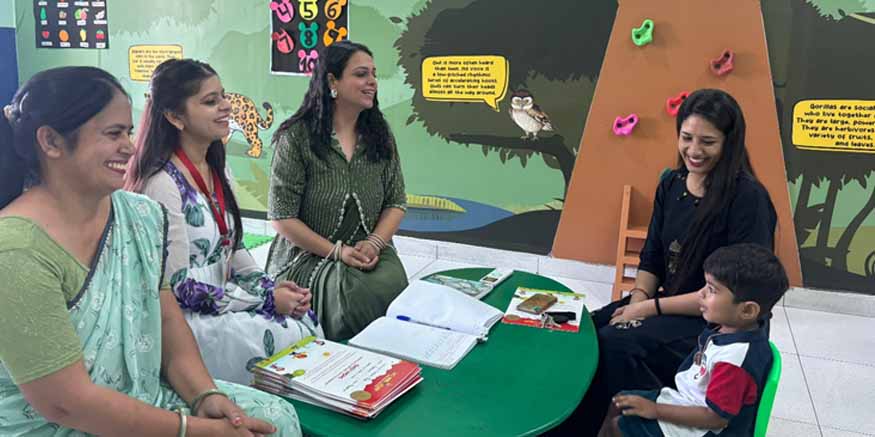
Parent-Teacher Meetings often get looked at as “report days,” but at Li’l Miracles, we see them as relationship-building days. Especially in the early years of a child’s life, communication between parents and teachers can shape how children grow—not just academically, but socially, emotionally, and even spiritually.
In the preschool years, children are learning how to:
- Express their feelings in words.
- Cooperate with friends.
- Follow routines.
- Stay curious about the world around them.
When parents and teachers connect during PTMs, it allows both sides to align on the child’s growth journey. Parents get to understand what’s working well in school, teachers get a glimpse of the home environment, and together, they can reinforce positive behaviors and address small concerns before they grow into challenges.
Think of it this way: A PTM is like holding a mirror from two directions—one reflecting the child’s progress in school and one reflecting their growth at home. Only when these two reflections meet, can we see the complete picture of the child’s development.
At Li’l Miracles, PTMs matter because they are not about numbers or checklists—they are about conversations, connections, and collective care.
Highlights of Our Q2 PTM
Our Q2 PTM was designed not just as a formal discussion but as a celebration of learning, growth, and togetherness. Parents walked in with curiosity and left with pride, seeing how their little ones are evolving every single day.
Here are some of the memorable highlights:
- Welcoming Environment: Parents were greeted with displays of their child’s work—colorful drawings, craft activities, and photographs of classroom moments. These visual stories helped them step into their child’s daily world.
- Detailed Progress Sharing: Teachers provided a balanced overview—highlighting strengths, appreciating efforts, and gently pointing out areas where children need a little more encouragement. This approach reassures parents that learning is a journey, not a race.
- Celebrating Achievements Together: Children proudly showcased small performances like songs, rhymes, or role-play skits. These joyful presentations reminded parents that every small milestone is a big achievement in early childhood.
- Parent-Teacher Dialogue: The most valuable part of PTMs at Li’l Miracles is always the two-way conversation. Parents shared observations about bedtime routines, speech habits, or playtime behaviors, while teachers offered simple, practical tips to support children at home. This dialogue ensures that the school and home environments complement each other beautifully.
- Parent Reflection Moments: To make the experience more engaging, we included reflective conversations around parenting practices—like the importance of storytelling, handling tantrums patiently, and building routines. These were not lectures but warm, friendly discussions where parents felt supported and heard.
- A Community Feel: Beyond individual sessions, the PTM also served as a gathering space where parents connected with one another, sharing experiences and realizing they’re not alone in their parenting journeys.
The essence of our Q2 PTM was this: It wasn’t about what children “achieved” in a quarter, but about how much they grew, explored, and enjoyed learning.
Parenting Takeaways from PTM
One of the most meaningful aspects of a PTM is not just knowing how your child is performing at school, but also understanding what you, as parents, can do at home to complement their growth. After all, children thrive best when their worlds—home and school—work in harmony.
During our Q2 PTM, many beautiful insights emerged through discussions between teachers and parents. Here are some important takeaways that can support every child’s learning journey:
- Consistency is Key
- Encourage Independence
- Celebrate Small Wins
- Balance Screen Time with Real Play
- Be a Patient Listener
- Reinforce School Learning at Home
- Parenting is Teamwork
Children love predictability—it makes them feel safe and secure. Just like they follow routines in school (morning greetings, snack time, story sessions), setting simple, consistent routines at home helps them feel stable.
Tip: Fix a bedtime, reading time, or even a small “helping mom/dad” chore routine. Over time, children begin to internalize discipline naturally.
It’s tempting to step in and help every time, but children learn more when they are trusted with small responsibilities. Independence builds confidence and problem-solving skills.
Example: Let them zip up their jackets, carry their own water bottles, or set the table. Even if it takes longer or isn’t “perfect,” the effort matters more than the outcome.
Every child is on their own unique timeline of growth. Applauding even the tiniest achievement creates motivation and joy.
Example: If your child shares a toy without being asked, say, “I love how kind you were today!” A small acknowledgment goes a long way in reinforcing values.
Screens are everywhere, but childhood is best built through touch, movement, and imagination. Active play not only builds physical strength but also sharpens social and emotional skills.
Tip: Swap 30 minutes of cartoons with puzzle-solving, outdoor play, or role-play games. Parents who model this balance often see children naturally gravitating toward more creative play.
Children sometimes struggle to put their feelings into words. When parents listen patiently—without rushing or judging—it gives children the courage to express themselves more freely.
Example: If your child comes home and says, “I don’t like school today,” pause and explore gently: “What made you feel that way?” You may discover it was something as small as not getting a turn on the swing.
Repetition helps children connect the dots. When what they learn in school is echoed at home, it builds stronger memory and confidence.
Tip: If they learned about colours in class, play a “colour hunt” game at home. If they learned a rhyme, sing it together at bedtime.
Perhaps the biggest takeaway is this: Parenting is not a solo journey. Teachers, parents, and the school community all play important roles. The more connected we are, the more supported the child feels.
At Li’l Miracles, we believe that PTMs are not just about progress reports—they are parenting workshops in disguise. Every conversation is a reminder that raising children is about patience, celebration, and teamwork.
A Heartfelt Thank You
We are deeply grateful to all parents who joined us for the Q2 PTM. Your involvement, encouragement, and willingness to walk hand-in-hand with us is what makes Li’l Miracles truly special.
At the end of the day, a child’s success is not measured only in grades or milestones, but in the love, support, and teamwork they see between their parents and teachers.
Together, we are not just educating children—we are nurturing the guardians of tomorrow.
💌 To all parents: Thank you for trusting us, supporting us, and believing in us. Your faith in our mission keeps us going every single day.
For more such learnings, read our blogs at www.lilmiracles.in
Lalit Sharma
Founder
Li’l Miracles International Preschool