A PTM Shouldn’t Be a Report Card. It Should Be a Conversation:
A parent-teacher meeting is often associated with one simple question:
“How is my child doing?”
But perhaps a more meaningful question is:
“How can we understand this child better — together?”
For a preschooler, learning is not limited to letters, numbers, worksheets or classroom activities.
A child is learning how to communicate.
How to make friends.
How to express emotions.
How to follow routines.
How to become independent.
How to respond when something feels difficult.
How to participate.
How to ask for help.
And while teachers see many of these moments at school, parents see another equally important side of the child at home.
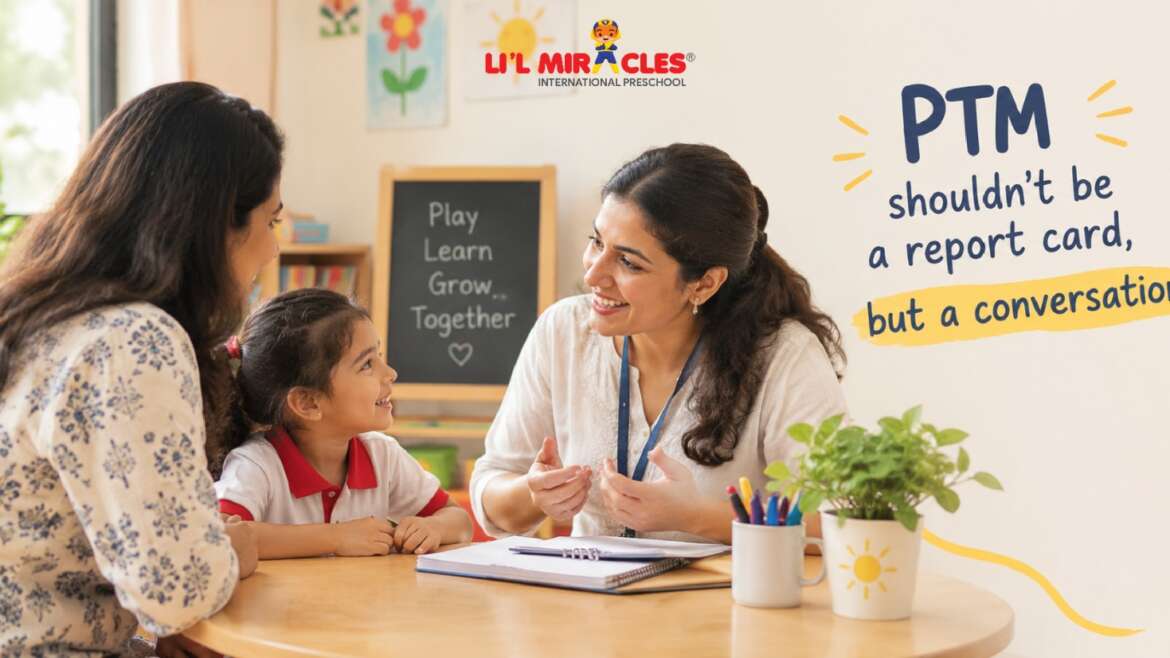
That is why a Parent-Teacher Meeting should not simply be a time when one adult talks and another listens.
It can become something much more meaningful.
A conversation.
At Li’l Miracles International Preschool, we believe that early childhood education becomes stronger when parents and teachers work together.
The teacher observes.
The parent shares.
Both understand.
And the child benefits.
What Is the Real Purpose of a PTM?
A PTM is often thought of as a time to discuss a child’s academic progress.
But during the early years, a child’s development is much broader than academic performance.
A meaningful PTM can create space to talk about:
A child’s interests.
Their strengths.
Their classroom participation.
Their friendships.
Their communication.
Their emotional responses.
Their independence.
Their challenges.
Their progress.
And the small changes that adults may notice over time.
For a young child, these details matter.
Because every child is developing at their own pace.
And sometimes, understanding the child is more important than simply measuring the child.
- A Teacher Sees the Child in a Different World
- Parents Bring Another Part of the Picture
- When Two Perspectives Come Together, Understanding Becomes Deeper
- A PTM Is Not Only About What Needs Improvement
- Small Behaviours Can Tell Big Stories
- Parents and Teachers Can Share What Works
- The Child Benefits When Adults Work as a Team
- Five Simple Ways to Make a PTM More Meaningful
- Let Parents and Teachers Ask Questions Too
A preschool teacher observes children in a classroom full of experiences.
They see how a child enters the classroom.
How they participate in group activities.
Whether they volunteer to answer.
How they interact with classmates.
How they respond when they make a mistake.
Whether they ask for help.
How they manage transitions.
Whether they enjoy certain activities more than others.
These may seem like small observations.
But together, they can tell a teacher a great deal about a child’s developing personality, confidence and learning style.
A teacher may notice:
“Your child loves storytelling.”
“Your child participates more during hands-on activities.”
“Your child takes a little time before joining a group.”
“Your child has become more confident about speaking.”
These observations are not simply comments on performance.
They are pieces of a bigger picture.
Teachers know the child in the classroom.
Parents know the child beyond the classroom.
They know the little things that may never appear during a school day.
Perhaps the child talks continuously about one particular topic at home.
Perhaps they have recently become interested in drawing.
Perhaps they have started asking many questions.
Perhaps something has changed in their routine.
Perhaps they are becoming more independent.
Perhaps they are experiencing a new emotion or adjustment.
Parents can bring these everyday observations into the PTM.
And sometimes, one small piece of information from home can help a teacher understand a classroom behaviour differently.
Because a child is never only a student.
They are a child with a life beyond the classroom.
Imagine a teacher notices that a child has become quieter during group activities.
The teacher observes.
The parent shares that there has been a change in the child’s routine at home.
Suddenly, the behaviour has more context.
Or perhaps a teacher notices that a child is extremely confident during creative activities.
The parent shares that the child spends a lot of time drawing at home.
Now, a shared interest has been discovered.
This is where a PTM becomes powerful.
The teacher does not have to understand everything alone.
The parent does not have to understand everything alone.
Together, they can connect the pieces.
Teacher observes.
Parent shares.
Both understand.
And the child receives more consistent support.
Sometimes conversations about a child’s progress can unintentionally become focused only on what needs to change.
But every child also has strengths worth celebrating.
A PTM can be an opportunity to talk about:
“What does your child enjoy?”
“What makes them confident?”
“What are they doing independently now?”
“What has improved?”
“What are they curious about?”
“What makes them feel comfortable?”
“What are their natural strengths?”
When adults recognise these qualities, they can build learning around them.
A child who loves stories may become more interested in language.
A child who loves building may explore mathematical concepts through shapes and patterns.
A child who enjoys helping may develop greater responsibility.
A child’s strength can become a doorway to further learning.
Preschool children often communicate through behaviour before they can fully explain their feelings with words.
A child who refuses to participate may not simply be “not interested”.
They may be tired.
Unsure.
Overwhelmed.
Shy.
Or simply need more time.
A child who keeps interrupting may be trying to express excitement.
A child who avoids an activity may need encouragement.
A child who prefers playing alone may need gentle support in joining a group.
This does not mean every behaviour has a hidden problem.
It simply means that children deserve to be understood before they are judged.
A PTM creates space for teachers and parents to ask:
“What might this behaviour be telling us?”
That question can change the entire conversation.
Every child responds differently.
Some children learn best through pictures.
Some through movement.
Some through stories.
Some through repetition.
Some need encouragement before they participate.
Some become confident when they are given responsibility.
Parents often discover strategies at home that work beautifully for their child.
Teachers discover strategies in the classroom.
A PTM can bring these ideas together.
“Have you tried this at home?”
“This seems to work well in class.”
“They respond positively when we give them time.”
“They enjoy choosing between two options.”
These small exchanges can help adults create greater consistency between home and school.
Children may not sit inside a PTM.
But they are at the centre of it.
When parents and teachers communicate openly, the child receives a stronger support system.
The child experiences familiar expectations.
Adults understand their needs better.
Strengths can be encouraged in both environments.
Challenges can be approached with greater consistency.
And progress can be noticed more meaningfully.
The goal is not for the parent and teacher to have identical approaches.
It is to understand the child well enough to support them together.
Because children do not need adults who always agree.
They need adults who are willing to listen, understand and work together for them.
You don’t need a complicated meeting agenda.
The simplest conversations can often become the most valuable.
💬 Come With Questions
Parents can ask about their child’s interests, friendships, participation and confidence — not only academics.
👂 Listen Before Responding
A PTM becomes more meaningful when both sides have space to speak.
🏡 Share Home Observations
Small changes in behaviour, routines or interests can give teachers useful context.
🌱 Talk About Strengths Too
Every conversation should make space for what the child is doing well.
🤝 End With a Shared Understanding
Instead of simply discussing what happened, parents and teachers can think about what they can do next to support the child.
A PTM does not need to end with a list of problems.
It can end with a shared question:
“How can we help this child grow?”
Perhaps one of the most important things about a PTM is that neither side needs to have every answer ready.
A parent may ask:
“Why does my child behave differently at school?”
A teacher may ask:
“Have you noticed this at home?”
A parent may say:
“They have recently started doing this.”
A teacher may respond:
“We’ve noticed something similar here.”
These questions are not signs that something is wrong.
They are signs that adults are trying to understand.
And when adults make space for these conversations, children benefit from something very important:
Being understood from more than one perspective.
A PTM Through the Eyes of a Child
For an adult, a PTM may simply be a meeting.
A teacher sits with a parent.
They discuss progress.
They share observations.
They talk about what comes next.
But for a child, something much bigger is happening behind that conversation.
Adults are talking about me.
They are noticing me.
They are learning what I enjoy.
They are understanding what I find difficult.
They are celebrating what I can do.
They are thinking about how to help me.
And somewhere within that conversation, a child is being supported by two important worlds coming together.
School.
Home.
At Li’l Miracles International Preschool, we believe that early childhood education is not about separating “learning” from “life”.
Learning happens through play.
Through relationships.
Through conversations.
Through observation.
Through encouragement.
And through the partnership between the adults who care for a child.
Perhaps that is what a meaningful PTM should really be.
Not a report being handed over.
Not a list of strengths and weaknesses.
Not a one-way conversation.
But a moment where two people who know the child in different ways come together to understand them better.
The teacher observes.
The parent shares.
Both understand.
The child benefits.
Because when adults listen to each other, children receive something even more valuable than a progress report.
They receive understanding.
They receive consistency.
They receive encouragement.
And they receive the confidence of knowing that the important adults in their lives are working together for them.
At Li’l Miracles International Preschool, we believe in nurturing children who are curious, confident, compassionate and connected — children who can explore the world with confidence while knowing that the adults around them are there to listen, guide and support them.
Because education isn’t only about teaching a child.
It is also about understanding the child.
And sometimes, the most meaningful learning begins with a conversation.
Li’l Miracles International Preschool
Where Learning Begins with Happiness.
For more such parenting and early childhood learning insights, visit www.lilmiracles.in.