Ganpati Bappa and Little Hearts: What Ganesh Chaturthi Can Teach Preschoolers
Ganpati Bappa Morya!
For children, festivals are often filled with colours, music, decorations, sweets, new clothes and happy family gatherings. But behind all the excitement is something even more meaningful — an opportunity to help children understand values, traditions, relationships and the world around them.
Ganesh Chaturthi is one such festival.
For adults, the days of Ganpati may be familiar traditions we have grown up with. For a preschooler, however, they can become something wonderfully new: a chance to ask questions, listen to stories, make something with their hands, participate in family rituals and discover why people come together to celebrate.
At Li’l Miracles International Preschool, we believe that early childhood learning does not happen only through worksheets, alphabets or numbers.
It happens through stories.
Through conversations.
Through play.
Through culture.
And through the experiences children share with the people around them.
Ganesh Chaturthi gives families a beautiful opportunity to bring all of these together.
What Are the Days of Ganpati?
Ganesh Chaturthi marks the celebration of Lord Ganesha and is traditionally observed with prayers, family and community gatherings, decorations and cultural celebrations.
In many parts of India, Ganeshotsav is celebrated over several days, traditionally culminating in Anant Chaturdashi, when the idol is taken for visarjan.
For a young child, these days can be introduced very simply.
Instead of focusing only on the religious aspects, parents can help children understand the festival through age-appropriate ideas:
A festival brings people together.
Traditions connect us to our families and culture.
Celebrations can be joyful while also being responsible.
Every goodbye can teach us about change and letting go.
And perhaps most importantly:
Learning about a tradition is also learning about where we come from.
- Stories Turn a Festival Into a Learning Experience (H2)
- 2 GANPATI CAN BECOME A LESSON IN COURAGE AND PROBLEM SOLVING
- The Modak Can Become a Little Learning Laboratory
- Counting ingredients
- Identifying shapes and textures
- Measuring
- Mixing
- Observing changes while cooking
- Following a sequence
- Learning new vocabulary
- Helping serve the family
- Festivals Help Children Understand Belonging
- Creativity Comes Alive During Ganpati
- Ganpati Can Teach Children About Caring for Nature
- Visarjan Can Introduce Children to the Idea of Letting Go
- Ganpati Teaches Us That Celebrations Are About People Too
- Five Simple Ways to Celebrate Ganpati With Your Preschooler
- Let Children Ask Questions
“Why does Ganpati have an elephant head?”
“Why do we bring Ganpati home?”
“Why do people say Ganpati Bappa Morya?”
“Why do we do visarjan?”
Preschoolers naturally ask questions.
And festivals give parents an opportunity to answer them through simple stories.
Children do not need a complicated explanation of mythology. A short, age-appropriate story, told with expressions and pauses, can be enough to capture their imagination.
As they listen, children learn to follow a sequence of events, remember characters, understand emotions and ask questions.
A story can become a conversation.
A conversation can become a learning experience.
And a learning experience can become a memory.
This is one reason storytelling is so powerful during the early years.
Just as grandparents can turn stories from their childhood into lessons in language, imagination and emotional understanding, family members can use festival stories to help children connect with traditions in a personal way.
Preschoolers are constantly learning how to deal with little challenges.
A block tower falls.
A puzzle doesn’t fit.
A friend takes a toy.
A drawing doesn’t turn out the way they imagined.
These moments may seem small to adults, but they are important learning opportunities for children.
Stories associated with Lord Ganesha can open conversations about facing challenges, thinking differently and finding solutions.
Parents can ask:
“What could you do if something feels difficult?”
“Would you give up if your first idea didn’t work?”
“Can we think of another way?”
The objective is not to turn a festival story into a formal lesson.
It is simply to help children connect stories with everyday experiences.
Because at the preschool age, values become meaningful when children can see them in their own world.
Ganpati and modaks are almost inseparable in the minds of many families.
And for a preschooler, a kitchen filled with the aroma of freshly prepared food can become an exciting learning environment.
With appropriate adult supervision, children can participate in simple steps such as:
“Can you count five modaks?”
“Which one is bigger?”
“What does the dough feel like?”
“What comes first?”
Simple questions can turn an everyday preparation into an opportunity for mathematical thinking, sensory exploration, language development and sequencing.
More importantly, when a child participates in preparing something for the family, they experience a small but powerful feeling:
“I can help too.”
That feeling of capability is an important foundation for confidence
Children need to know that they are part of something bigger than themselves.
Family traditions can help create that feeling of belonging.
Perhaps the family decorates the house together.
Perhaps grandparents tell children how Ganpati was celebrated when they were young.
Perhaps everyone gathers for aarti.
Perhaps the child helps arrange flowers or makes a small decoration.
These moments tell a child:
“This is something we do together.”
Culture becomes much more meaningful when children experience it with people they love.
As we believe at Li’l Miracles, children can be encouraged to look towards the future while remaining connected to their roots.
Give a preschooler clay, paper, colours or flowers and something wonderful happens.
They begin to create.
Ganpati celebrations naturally offer many opportunities for hands-on creativity:
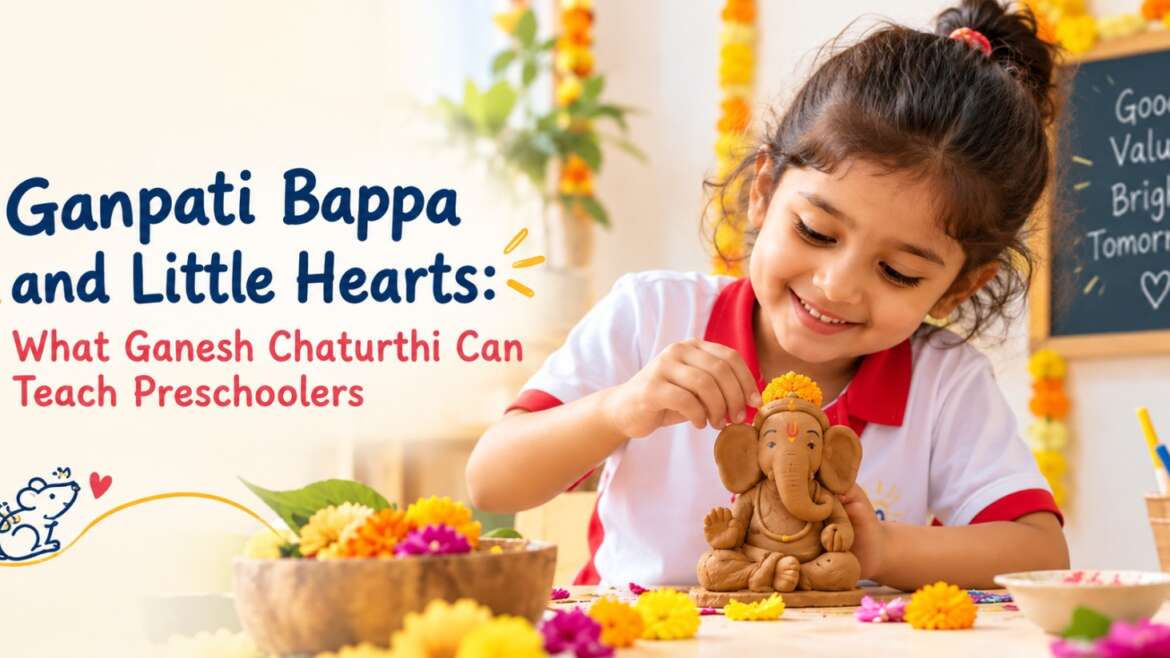
Make a Clay Ganesha
Give your child natural clay or suitable modelling dough and let them create their own simple Ganesha.
The goal isn’t perfection.
There is no need for the idol to look “right”.
Let the child explore shapes, textures and forms.
Ask:
“What shape will you make for the ears?”
“How will you make the trunk?”
“What can you use for the eyes?”
This encourages fine-motor development, imagination, hand-eye coordination and creative expression.
And most importantly, it allows children to create something rather than simply consume something.
Festivals can also become opportunities to introduce children to environmental responsibility.
Eco-friendly celebrations encourage families to think about the materials they use, the waste they generate and what happens after the celebration ends.
Government initiatives have specifically encouraged natural clay idols and more sustainable Ganesh celebrations, with children and schools also participating in eco-friendly idol-making activities.
For preschoolers, this doesn’t need to become a complicated environmental lesson.
It can simply begin with questions like:
“Where does clay come from?”
“What happens when clay gets wet?”
“Can we decorate without using lots of plastic?”
“Can we reuse this decoration?”
“Where should we put our waste?”
These small conversations can gradually build environmental awareness.
Children begin to understand that celebrating something we love does not mean forgetting to care for the world around us.
For adults, visarjan can carry deep spiritual and emotional meaning.
For a young child, it can be confusing.
“Why are we taking Ganpati away?”
“Why can’t we keep Bappa forever?”
These questions are natural.
Parents can explain the idea in a simple and gentle way.
Some celebrations have a beginning, a beautiful middle and an ending. The ending does not mean that the love, memories or values associated with the celebration disappear.
For preschoolers, this can become an early conversation about change, transition and letting go.
Children experience small versions of this every day.
Saying goodbye to a parent at school.
Finishing a favourite activity.
Leaving the playground.
Moving from one classroom to another.
Ending a holiday.
Visarjan can therefore become a gentle opportunity to help children understand that saying goodbye is also a part of life.
Look beyond the idol.
Look at the people.
Grandparents telling stories.
Parents preparing food.
Children decorating.
Neighbours greeting each other.
Friends sharing prasad.
Communities coming together.
This is where much of the learning happens.
Children observe how adults cooperate, help one another, share responsibilities and participate in a community.
And children learn values not only because adults explain them, but because they see them being practised.
Sharing food can introduce generosity.
Helping decorate can introduce cooperation.
Waiting for their turn can introduce patience.
Helping clean up can introduce responsibility.
Saying thank you can introduce gratitude.
As our reference piece on intergenerational learning highlights, children often experience values most meaningfully through everyday interactions rather than simply memorising them.
You don’t need to create a complicated activity schedule.
The simplest experiences can often become the most memorable.
🪔 Make a Little Ganpati Corner
Allow your child to help decorate a small space with flowers, paper decorations or their own artwork.
Let them make some of the decisions.
🎨 Create With Clay
Make a small eco-friendly Ganesha together.
Talk about the texture of clay, the shapes you are creating and what happens to clay when it gets wet.
📖 Tell a Ganpati Story
Choose one simple story and tell it without rushing.
Pause.
Ask questions.
Let your child interrupt.
Let them tell parts of the story back to you.
🍚 Make a Family Favourite
Prepare a simple festival food together under supervision.
Allow your child to count, mix, arrange or serve where appropriate.
🌱 Celebrate Green
Choose reusable decorations, reduce unnecessary plastic and explore a natural-clay idol.
A sustainable celebration can become a lesson in responsibility without taking away from the joy of the festival.
Perhaps the most important thing parents can do during festivals is not to have every answer ready.
It is to make space for questions.
“Why?”
“How?”
“What happens next?”
“Who started this?”
“Why do we do this every year?”
These questions are not interruptions.
They are signs of curiosity.
When adults welcome these questions, children learn something much bigger than the answer itself:
My questions matter.
That is the kind of confidence we want children to carry into their classrooms, friendships and lives.
Ganpati Bappa Through the Eyes of a Child
For an adult, Ganesh Chaturthi may bring memories of childhood, family traditions and familiar rituals.
For a preschooler, it may be the first time they are truly noticing everything.
The bright decorations.
The music.
The flowers.
The stories.
The modaks.
The clay.
The family gathering.
The excitement of saying “Ganpati Bappa Morya!”
And somewhere within all that excitement, a child is learning.
Learning to listen.
Learning to create.
Learning to participate.
Learning to share.
Learning to care.
Learning to ask questions.
Learning that traditions have stories.
And learning that celebrations can bring people together.
At Li’l Miracles International Preschool, we believe that early childhood education is not about separating “learning” from “life”.
Learning happens through play.
Through stories.
Through relationships.
Through culture.
Through questions.
Through creativity.
And through the little experiences that children carry with them long after the day is over.
Perhaps that is the most beautiful way to celebrate Ganpati with a child.
Not by simply telling them what the festival means.
But by allowing them to experience it.
To touch it.
To question it.
To create through it.
To celebrate it with their family.
And slowly, in their own little way, to understand it.
Because when a child asks,
“Bappa, phir kab aaoge?”
there is more than a question in those little words.
There is attachment.
There is wonder.
There is love.
And there is a childhood memory quietly being created.
At Li’l Miracles International Preschool, we believe in nurturing children who are curious, confident, compassionate and connected — children who can explore the future while staying rooted in values that matter.
Because education isn’t only about preparing children for tomorrow.
It is also about helping them understand the stories, relationships and traditions that have shaped where they come from.
Ganpati Bappa Morya! ❤️
Li’l Miracles International Preschool
Where Learning Begins with Happiness.
For more such learnings, read our blogs at www.lilmiracles.in
Riitu Sharma
Co-founder
Li’l Miracles International Preschool.
Co-founder