Little Hands, Big Safety: Helping Children Understand Electrical Safety :
Electricity is everywhere.
The lights we switch on.
The fans that keep us cool.
The appliances we use every day.
The chargers, plugs and wires we see around us.
For adults, these are ordinary parts of everyday life. For a young child, however, they can be fascinating objects that naturally invite curiosity.
And that curiosity can become an opportunity to teach something extremely important — how to stay safe around electricity.
At Li’l Miracles International Preschool, we believe that some of the most important lessons for children begin with the things they see around them every day.
Safety is not something children should learn only through warnings.
It can be introduced through conversations.
Through pictures.
Through real-world examples.
Through observation.
And through simple experiences that help children understand why a safety rule matters.
Our Electrical Safety Awareness activity was designed with this very idea in mind.
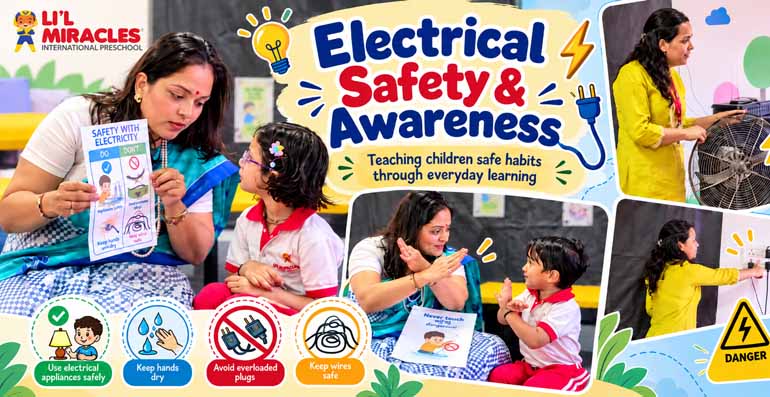
The children were introduced to familiar electrical equipment, colourful safety posters and simple everyday situations. Instead of simply telling them what not to do, we encouraged them to observe, think, answer questions and understand how they can make safer choices.
Electrical Safety Begins With Awareness
For a young child, electrical safety can be introduced through very simple ideas:
Electricity is useful, but it must be used safely.
Electrical appliances are useful tools, not toys.
Sockets, wires and plugs are not things to experiment with.
If something looks damaged or unsafe, children should stay away and tell an adult.
And perhaps most importantly:
Knowing what is unsafe is the first step towards staying safe.
- Everyday Objects Can Become Powerful Learning Experiences
- Electricity Is Helpful — When We Use It Safely
- Switches and Plugs Teach Children About Responsibility
- Sockets Are Not for Little Fingers
- Wires Are Not Toys
- Do not pull wires.
- Do not play with wires.
- Never touch exposed or damaged wires.
- Never touch a fallen wire.
- Tell an adult if a wire looks unsafe.
- Wet Hands and Electricity Do Not Mix
- Electrical Devices Are Useful — But They Are Not Toys
- What Should Children Do When They See a Problem?
- Learning Through Posters, Questions and Real-World Examples
- Simple Safety Rules Children Can Remember
Children see switches, plugs, sockets, wires and electrical appliances almost every day.
But seeing something regularly does not necessarily mean understanding how to stay safe around it.
This is why real-world examples can make safety learning meaningful.
During the activity, children were introduced to familiar electrical equipment and encouraged to recognise the objects they may see at home or in school.
A switch can become a conversation.
A plug can become a question.
A wire can become a safety lesson.
An everyday electrical appliance can become an opportunity to understand responsibility.
When children can connect a classroom lesson with something they have actually seen, the learning becomes easier to remember.
One of the first messages shared with the children was simple:
“Electricity is helpful when we use it safely.”
Electricity helps us light rooms, run fans and operate many of the appliances that make our daily lives easier.
But children also need to understand that useful things still need to be handled carefully.
The purpose was not to make children afraid of electricity.
It was to help them develop respect and awareness around it.
Because safety education is not about creating fear.
It is about creating understanding.
A switch may look like a very small part of a room.
But it can introduce an important habit — using electrical items carefully and switching them off when they are not in use.
Through the visual poster and real-world examples, children were encouraged to understand that switches and plugs should be handled carefully.
They also learned that electrical devices should not be operated simply out of curiosity.
Small habits can become important safety habits when introduced early.
Preschoolers are naturally curious.
They want to touch.
They want to explore.
They want to know what happens when they put something somewhere.
But electrical sockets are not meant for exploration.
The children were shown the safety message:
“Don’t put fingers in sockets.”
The visual made the rule easy to understand.
The conversation helped them connect it with real situations they may encounter at home.
The message was simple:
Sockets are for plugs — not for fingers or objects.
And when curiosity meets something unsafe, the safest choice is to step away and tell an adult.
Wires can look ordinary to children.
They may see them connected to televisions, chargers, computers, fans and other appliances.
But wires are not toys.
Through the posters and real-world examples, children learned:
A simple visual message such as “Wires are not toys!” can stay with a child long after the activity is over.
Because sometimes, a short sentence can become a very important safety habit.
Children learn many everyday hygiene habits.
Wash your hands.
Keep yourself clean.
Stay safe.
Electrical safety adds another important idea:
Electrical switches and appliances should not be handled with wet hands.
Through discussion and visual examples, children were encouraged to understand why staying dry around electrical items is important.
This turns an everyday situation into a practical safety lesson.
“What should you do before touching a switch?”
The answer is simple:
Make sure your hands are dry.
A hair dryer, charger, computer, television or other electrical appliance may look interesting to a child.
But interesting does not mean safe to play with.
Children were encouraged to understand that electrical devices have a purpose and should be used appropriately.
They should not experiment with them.
They should not play with them.
And whenever an electrical device requires handling beyond what is appropriate for a child, an adult should take over.
This is an important part of helping children understand boundaries.
Some things can be explored.
Some things should only be observed.
And some things require an adult’s help.
Perhaps one of the most important lessons of the activity was not about what children should touch.
It was about what they should do when something looks wrong.
A damaged wire.
A fallen wire.
A broken electrical item.
Something unusual near a socket.
A problem with an electrical appliance.
The answer is not to investigate.
The answer is not to repair it.
The answer is:
Stay away and tell an adult.
Children were encouraged to understand that asking a trusted adult for help is not a weakness.
It is a smart and responsible choice.
The colourful posters used during the activity helped turn safety rules into simple visual messages.
But the learning did not stop with the posters.
The children were also shown real-world electrical equipment and familiar examples, allowing them to connect what they saw in the visuals with things they may encounter in everyday life.
This combination made the activity more meaningful.
Children could look.
They could identify.
They could answer.
They could share what they already knew.
And they could understand how a simple safety rule applies to their own surroundings.
This is one reason experiential learning is so valuable during the early years.
A picture can introduce an idea.
A real object can make it familiar.
And a conversation can help a child remember it.
You don’t need complicated explanations to introduce electrical safety to young children.
The simplest rules can often be the most memorable.
⚡ Never put fingers or objects into sockets.
🔌 Use switches and plugs carefully.
💧 Never touch electrical items with wet hands.
🧵 Never pull or play with wires.
⚠️ Never touch damaged or fallen wires.
🚫 Do not play with electrical devices.
👩🏫 If something looks unsafe, tell an adult.
These simple messages can gradually become part of a child’s everyday awareness.
Electrical Safety Through the Eyes of a Child
For an adult, a switch is simply a switch.
A wire is simply a wire.
A plug is simply a plug.
But for a preschooler, these ordinary objects can become questions.
“What does this do?”
“Can I touch it?”
“Why can’t I put my finger here?”
“What happens if the wire breaks?”
“Who should I tell?”
And somewhere within those questions, a child is learning.
Learning to observe.
Learning to pause.
Learning to recognise danger.
Learning to make safer choices.
Learning to ask for help.
Learning that being careful is also being responsible.
At Li’l Miracles International Preschool, we believe that early childhood education is not about separating “learning” from “life”.
Learning happens through play.
Through conversations.
Through observation.
Through real-world experiences.
Through questions.
And through the little lessons that help children understand the world around them.
Electrical safety may seem like a serious topic for little children.
But when introduced through simple language, colourful visuals, familiar equipment and real-life examples, it can become an empowering lesson rather than a frightening one.
Because the goal is not to make children afraid of electricity.
The goal is to help them know when to stop, when to step away and when to ask an adult for help.
And perhaps that is the most valuable lesson of all:
Be safe.
Be smart.
And always speak up when something doesn’t feel safe.
At Li’l Miracles International Preschool, we believe in nurturing children who are curious, confident, responsible and aware — children who can explore the world around them while learning how to stay safe in it.
Because education isn’t only about preparing children for tomorrow.
It is also about giving them the awareness and confidence they need for today.
Top of Form
For more such learnings, read our blogs at www.lilmiracles.in
Riitu Sharma
Co-founder
Li’l Miracles International Preschool.
Bottom of Form