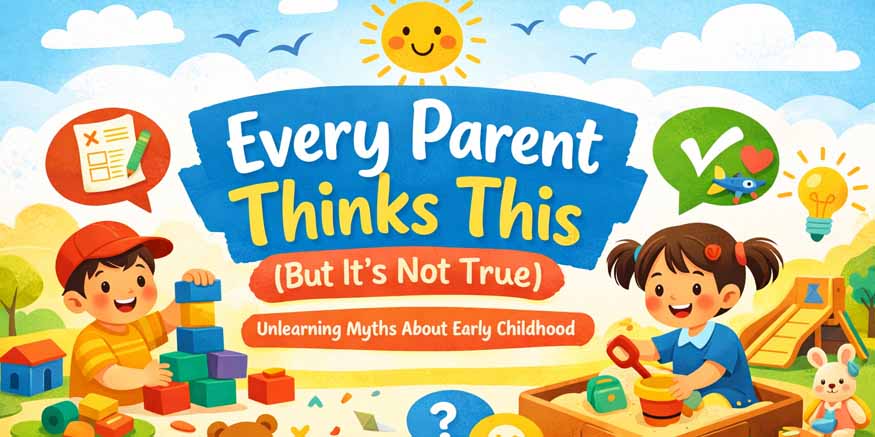
As parents, the intention is always pure — to give children the best start in life.
But in today’s fast-paced, comparison-driven world, it’s easy to confuse early success with right development.
At Li’l Miracles International Preschool, we interact with parents every single day — we listen, we understand, and we notice a pattern. Many concerns come from a place of love, but are shaped by common myths that have been passed down over time.
This blog isn’t about pointing out mistakes.
It’s about gently reframing perspectives — because sometimes, the most powerful parenting shift begins with unlearning.
Myth 1: “My child should start writing early to stay ahead.”
It’s one of the most common expectations — that if a child starts writing earlier, they’ll perform better academically later.
But here’s the truth:
Writing is not just about holding a pencil. It is a complex skill that requires:
- Fine motor strength
- Hand-eye coordination
- Finger control
- Posture stability
When children are pushed into writing too early, without these foundational skills, it can lead to:
- Frustration
- Poor grip habits
- Disinterest in learning
At this stage, activities like:
- Clay molding
- Threading beads
- Coloring and free drawing
- Sand play
…are not “just play” — they are pre-writing exercises in disguise.
When the foundation is strong, writing comes naturally — and beautifully.
Myth 2: “More worksheets mean more learning.”
Worksheets often look like learning. They feel structured, measurable, and reassuring.
But early childhood learning doesn’t happen best on paper.
The reality is:
Young children learn through:
- Exploration
- Sensory experiences
- Movement
- Real-life interaction
A child stacking blocks is:
- Understanding balance and physics
- Learning patience and focus
- Solving problems independently
A child engaged in a pretend kitchen is:
- Building language skills
- Understanding social roles
- Expressing creativity
Worksheets may show results.
But experiences build understanding.
Myth 3: “If my child is playing, they’re not learning.”
This is perhaps the biggest misconception.
Play is often seen as a “break” from learning — when in reality, play is the learning.
During play, children naturally develop:
- Social skills (sharing, teamwork)
- Emotional intelligence (handling wins and losses)
- Communication skills
- Imagination and creativity
For example:
A simple game in the sandpit can teach negotiation, cooperation, and problem-solving — all without a single instruction.
Structured teaching tells a child what to think.
Play allows a child to learn how to think.
Myth 4: “A quiet child is a well-behaved child.”
Silence is often mistaken for discipline.
But children are naturally curious, expressive, and full of energy — and that’s a good thing.
An engaged child might:
- Ask endless questions
- Talk excitedly
- Move around
- Express big emotions
And all of this is a sign of:
- Cognitive engagement
- Emotional development
- A sense of safety and comfort
Suppressing this expression in the name of “discipline” can sometimes:
- Reduce confidence
- Limit curiosity
- Create hesitation in communication
Instead of aiming for quiet children, we aim for confident, expressive learners.
Myth 5: “Comparison motivates children to do better.”
In a world of report cards and social media, comparison has become almost automatic.
But for young children, comparison doesn’t inspire — it overwhelms.
Every child has their own:
- Pace of learning
- Interests
- Strengths
When compared constantly, children may begin to feel:
- “I’m not good enough”
- Fear of failure
- Pressure instead of joy
What works better?
- Encouragement
- Individual appreciation
- Celebrating small milestones
Confidence grows in acceptance, not comparison.
So, What Really Matters in the Early Years? (H2)
The early years are not about being the fastest.
They are about building the strongest foundation.
At Li’l Miracles, we focus on nurturing:
- Curiosity over correctness
- Confidence over competition
- Exploration over pressure
- Joy over performance
Because a child who:
- Loves learning
- Feels confident
- Thinks independently
…will naturally thrive in every stage that follows.
A Gentle Thought to Take Home
Parenting doesn’t come with a manual — and it’s okay to question, rethink, and grow along the way.
Because sometimes,
the best thing we can do for our children…
is to let go of what “everyone says”
and start trusting what they truly need.
Sometimes, unlearning is the first step to truly understanding your child.
For more such learnings, read our blogs at www.lilmiracles.in
Riitu Sharma
Co-founder
Li’l Miracles International Preschool