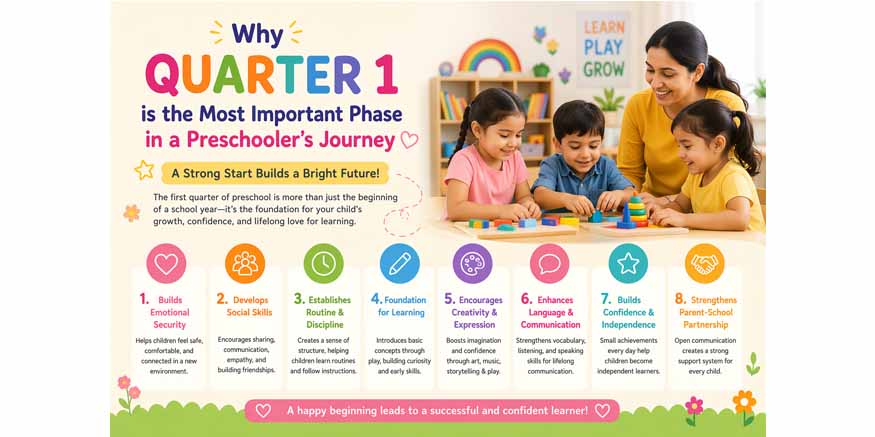
The first quarter of a preschool session is not just the beginning of an academic year—it is the foundation on which a child’s entire learning experience is built. For young learners stepping into a structured environment for the first time, these initial months are filled with emotional transitions, social adjustments, and cognitive development.
At this stage, every small step matters—and Quarter 1 plays a powerful role in shaping it all.
- Building Emotional Security
- Adjust to a new environment
- Build trust with teachers
- Develop a sense of comfort and belonging
- Developing Social Skills
- Sharing and taking turns
- Communicating with peers
- Understanding group behavior
- Basic manners and empathy
- Establishing Routine & Discipline
- Structured schedules (circle time, playtime, snack time)
- Following instructions
- Transitioning between activities
- Foundation for Learning
- Colors, shapes, and numbers
- Letter recognition and phonics
- Fine motor skills (holding crayons, tracing)
- Gross motor skills (running, jumping, balancing)
- Encouraging Creativity & Expression
- Express their thoughts through art, music, and storytelling
- Participate in creative activities like drawing, dancing, and pretend play
- Language & Communication Development
- Vocabulary
- Sentence formation
- Listening skills
- Building Confidence & Independence
- Keeping their belongings
- Eating independently
- Participating in class
- Strong Parent-School Partnership
- Parents understand their child’s progress
- Teachers understand each child’s unique needs
For many preschoolers, this is their first separation from parents. Quarter 1 helps children:
A secure child is more open to learning. When children feel safe, they naturally begin to explore, interact, and express themselves freely.
Preschool is often a child’s first social setting outside family. During Quarter 1, they learn:
These early interactions lay the groundwork for healthy relationships and teamwork skills in the future.
Young children thrive on routine. Quarter 1 introduces them to:
This consistency helps children feel secure and organized, while also building early discipline in a fun and gentle way.
This quarter focuses on basic concepts through play-based learning, such as:
Rather than academic pressure, the emphasis is on learning through exploration, which builds curiosity and confidence.
Quarter 1 is when children begin to:
These activities are essential for emotional expression, imagination, and confidence-building.
Children start improving their:
Through rhymes, conversations, and storytelling, Quarter 1 sets the stage for strong communication skills, which are crucial for lifelong learning.
Simple actions during this time—like:
…help children develop self-confidence and independence. These small achievements create a big sense of accomplishment.
Quarter 1 is also crucial for building trust between parents and educators. Regular updates, feedback, and communication ensure:
This partnership creates a supportive ecosystem for the child’s growth.
Conclusion
Quarter 1 is not about how much a child learns academically—it is about how well they settle, adapt, and begin to love learning.
A strong start leads to:
- Better engagement throughout the year
- Higher confidence
- Positive attitude towards school
When nurtured with care, patience, and creativity, these first few months become the most meaningful stepping stones in a child’s educational journey.
For more such learnings, read our blogs at www.lilmiracles.in
Riitu Sharma
Co-founder
Li’l Miracles International Preschool