Many parents wait eagerly for the day their child begins reading independently. The first time they hold a book, sound out letters, and proudly read a sentence aloud feels like a milestone.
But here’s something most parents don’t realize:
Reading does not begin when a child reads to you.
It begins when you read to them.
Long before a child recognizes the alphabet…
Long before phonics lessons…
Long before formal schooling…
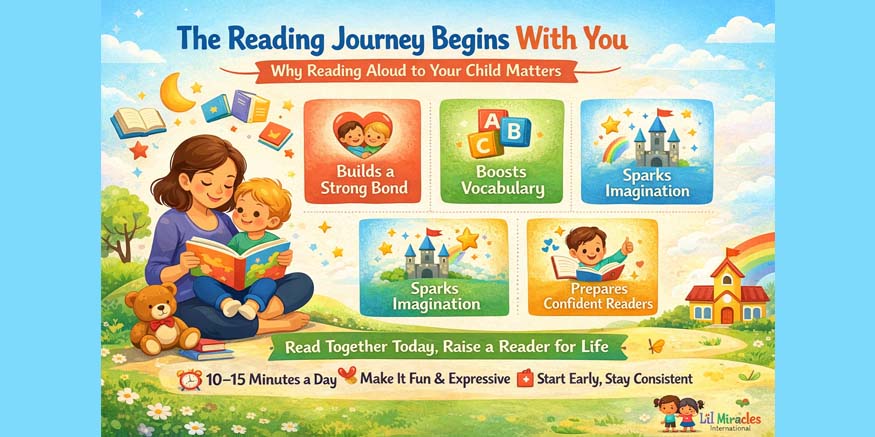
Their reading journey has already started — in your arms, through your voice.
- The Brain Begins Listening Before It Begins Speaking
- Your baby hears varied vocabulary.
- They begin to understand tone and rhythm.
- They absorb sentence structures.
- They learn how conversations flow.
- Reading Aloud Builds Emotional Security
- They feel safe.
- They feel connected.
- They associate books with comfort.
- Vocabulary Growth Without Pressure
- Descriptive words
- Emotions
- Story sequences
- Complex sentence structures
- Listening Is the First Step to Reading
- Listen attentively
- Follow a storyline
- Predict outcomes
- Understand cause and effect
- It Sparks Imagination in a Way Screens Cannot
- The forest.
- The characters.
- The emotions.
- The sounds.
- Reading Teaches Emotional Intelligence
- Joy
- Fear
- Kindness
- Disappointment
- Courage
- Confidence Begins Before School Begins
- Recognize how books work (front to back, page turning)
- Show curiosity about letters
- Ask questions about words
- Develop strong comprehension skills
- Reading Is Not About Performance
- Repeats the same book every night,
- Pretends to read from memory,
- Asks endless questions,
- Talks about the pictures,
- How to Make Reading Aloud Effective (Without Making It Complicated)
- The Long-Term Impact
- Develop strong language skills
- Perform better academically
- Show better concentration
- Exhibit empathy and emotional awareness
- Develop a lifelong love for books
From infancy, a child’s brain is developing at an extraordinary speed. Neural connections responsible for language, memory, and comprehension are forming every single day.
When you read aloud:
Even if your child cannot understand every word, their brain is mapping patterns of language. Repeated exposure builds familiarity, and familiarity builds confidence.
This early foundation makes later reading smoother and less stressful.
Reading time is not just educational — it is deeply emotional.
When a child sits in your lap and listens to your voice:
This emotional connection is powerful.
Children who experience reading as bonding time do not see books as “tasks.” They see them as companions.
And when books become friends early in life, learning becomes natural rather than forced.
Books often contain richer vocabulary than everyday conversations.
When you read stories regularly, your child is exposed to:
Without worksheets.
Without drills.
Without pressure.
This exposure builds what educators call language depth — the ability to understand and use words meaningfully.
By the time formal reading instruction begins, your child already carries a quiet advantage.
Before a child reads independently, they must learn to:
Reading aloud strengthens all of these skills.
In today’s screen-heavy world, sustained attention is becoming rare. Storytime gently trains the brain to slow down, focus, and imagine.
These listening skills directly impact classroom confidence later.
When you read a story instead of showing a video, something magical happens.
Your child must imagine:
Their brain creates the visuals.
This mental imagery strengthens creativity, problem-solving, and abstract thinking — skills that extend far beyond literacy.
Books don’t just tell stories.
They train the imagination.
Through stories, children experience:
They learn empathy by understanding characters’ feelings.
They learn problem-solving by watching how conflicts are resolved.
Stories become safe rehearsals for real-life emotions.
When children can identify feelings in books, they become better at expressing their own feelings in life.
Children who are read to regularly often:
When they enter preschool or kindergarten, they do not feel overwhelmed by books — they feel familiar with them.
That familiarity builds confidence.
And confidence builds love for learning.
Many parents worry:
“My child isn’t reading yet.”
“She doesn’t sit still.”
“He keeps interrupting the story.”
That’s okay.
Reading is not a test. It is a process.
If your child:
They are learning.
Every repetition strengthens neural pathways. Every question builds comprehension.
Independent reading is simply the visible outcome of years of invisible preparation.
You don’t need fancy techniques.
You need consistency and connection.
Here’s how:
✔ Start Early
Even newborns benefit from hearing your voice.
✔ Keep It Short but Daily
10–15 minutes daily is more powerful than one long session occasionally.
✔ Be Expressive
Change your tone. Add drama. Make it fun.
✔ Follow Their Interest
If they love animals, choose animal stories. If they love vehicles, pick transport books.
✔ Don’t Turn It Into a Lesson
Avoid quizzing too much. Let it be joyful.
Children who grow up being read to are more likely to:
But beyond all academic benefits, the most powerful impact is this:
They remember the feeling.
Years later, they may not remember every story —
but they will remember sitting beside you.
Final Thoughts
Reading to your child is not just about preparing them for school.
It is about:
- Building their brain
- Strengthening your bond
- Nurturing imagination
- Creating a secure foundation for life
So don’t wait for them to read to you.
Start today.
Because the reading journey doesn’t begin with phonics.
It begins with your voice.
For more such learnings, read our blogs at www.lilmiracles.in
Riitu Sharma
Co-founder
Li’l Miracles International Preschool